Lean Canvas Agent
Strategy & Knowledge • Work sample
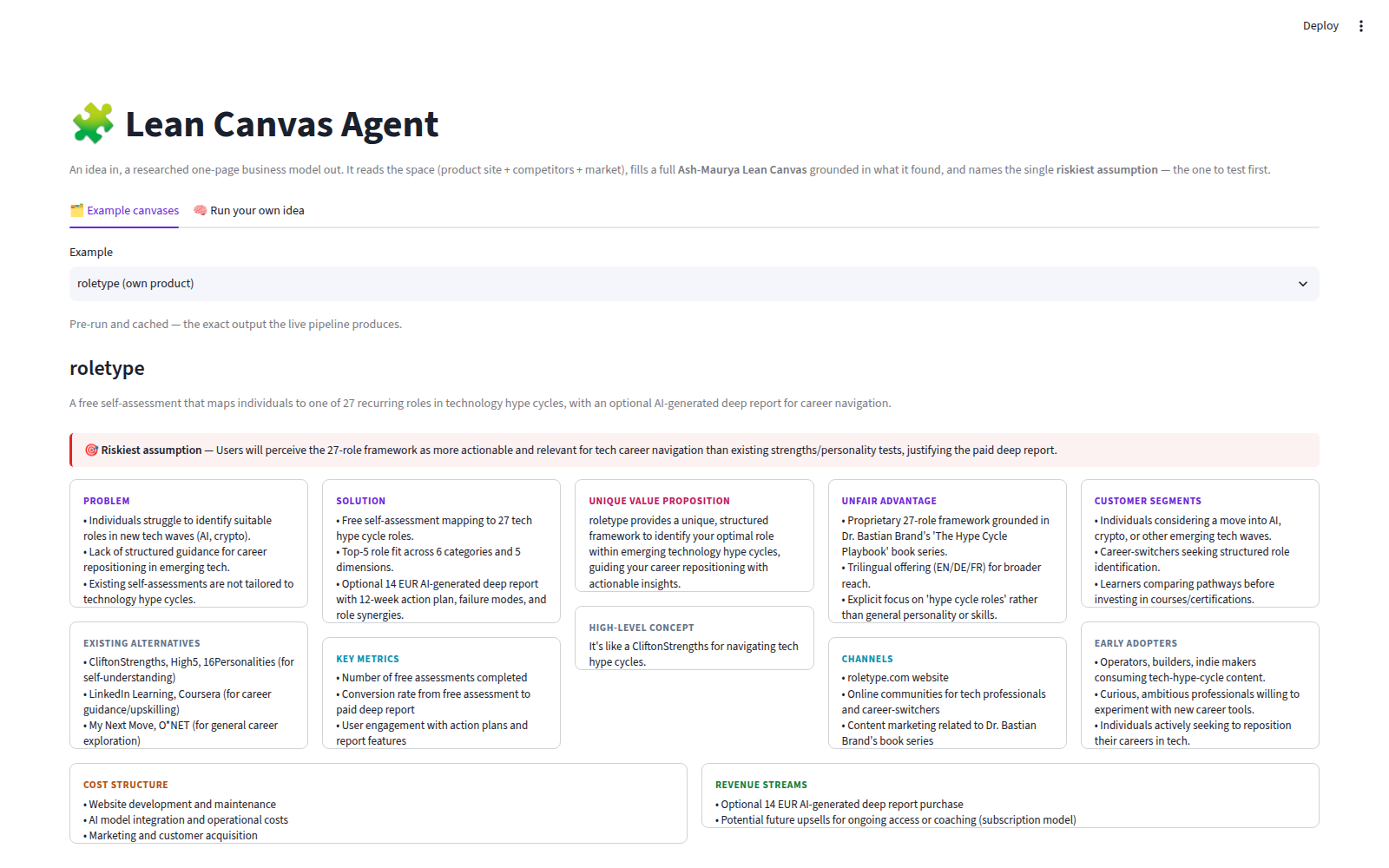
Live: canvas.bastian-brand.com
What it is
An idea in, a researched one-page business model out. Give it a product, company or a raw idea and it reads the space, fills a full Ash-Maurya Lean Canvas — all nine blocks, grounded in what it found — and names the single riskiest assumption: the one to test first, before writing any code. It turns “I have an idea” into an evidence-backed model you can pressure-test in a meeting.
How I built it
The research runs in three complementary modes, because no single one is enough. Firecrawl precisely scrapes the actual product pages. Perplexity Sonar (via OpenRouter) does broad, cited web research on competitors and market. And a deep-source pass runs filetype:pdf searches and parses the results — the analyst reports, market studies and whitepapers that a generic web search skips but where the substantive numbers actually live. An LLM then synthesises a structured canvas, told to treat a product’s own site as authoritative for what it is and to use the wider research only for market context. Where a company can’t be scraped, it works from a description instead — and it’s honest when the evidence is thin rather than inventing it.
Highlights
- Three research modalities — precise scrape + cited web research +
filetype:pdfdeep sources - Names the riskiest assumption, the Lean-Canvas point most tools skip
- Grounded by design: product site anchors positioning, research adds context, no invented facts
Stack
Python · Streamlit · Firecrawl · Perplexity Sonar (OpenRouter) · OpenRouter (LLM)